- Why do audiences choose to consume certain texts?
- How do they consume texts?
- What happens when they consume texts?
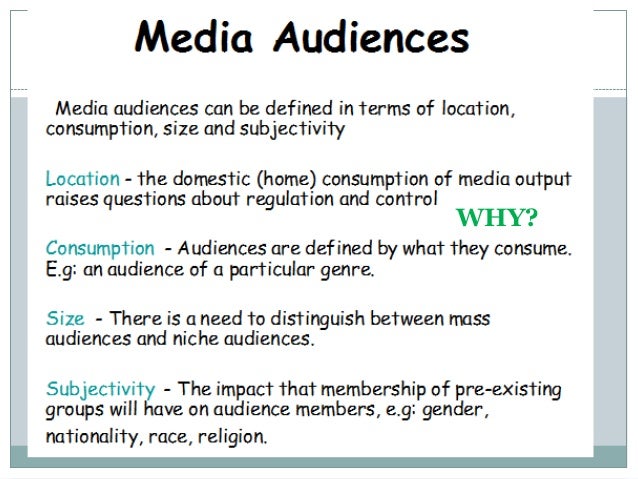
There are three theories of audience that we can apply to help us come to a better understanding about the relationship between texts and audience.
1. The Effects Model or the Hypodermic Model -
- The consumption of media texts has an effect or influence upon the audience
- It is normally considered that this effect is negative
- Audiences are passive and powerless to prevent the influence
- The power lies with the message of the text
Hypodermic Syringe…
> The messages in media texts are injected into the audience by the powerful, syringe- like, media
> The audience is powerless to resist
> Therefore, the media works like a drug and the audience is drugged, addicted, doped or duped.
The Bobo Doll Experiment…
- Children watched a video where an adult violently attacked a clown toy called a Bobo Doll
- The children were then taken to a room with attractive toys that they were not permitted to touch
- The children were then led to another room with Bobo Dolls
- 88% of the children imitated the violent behaviour that they had earlier viewed. 8 months later 40% of the children reproduced the same violent behaviour
2. The Uses and Gratifications Model
- The Uses and Gratifications Model is the opposite of the Effects Model
- The audience is active
- The audience uses the text & is NOT used by it
- The audience uses the text for its own gratification or pleasure

- Controversially the theory suggests the consumption of violent images can be helpful rather than harmful
- The theory suggests that audiences act out their violent impulses through the consumption of media violence
- The audience’s inclination towards violence is therefore sublimated, and they are less likely to commit violent acts
3. Reception Theory
- Given that the Effects model and the Uses and Gratifications have their problems and limitations a different approach to audiences was developed by the academic Stuart Hall at Birmingham University in the 1970s
- This considered how texts were encoded with meaning by producers and then decoded (understood) by audiences
- When a producer constructs a text it is encoded with a meaning or message that the producer wishes to convey to the audience
- In some instances audiences will correctly decode the message or meaning and understand what the producer was trying to say
- In some instances the audience will either reject or fail to correctly understand the message
Stuart Hall identified three types of audience readings (or decoding) of the text:
1. Dominant or preferred - Where the audience decodes the message as the producer wants them to do and broadly agrees with it
2. Negotiated - Where the audience accepts, rejects or refines elements of the text in light of previously held views
3. Oppositional - Where the dominant meaning is recognised but rejected for cultural, political or ideological reasons

No comments:
Post a Comment