Tuesday, 30 September 2014

Research: Choosing a broadcast channel

I consider the three main broadcasters to be BBC, Channel 4 and ITV...

For documentaries in particular however, I have researched into the BBC and Channel 4 and their audience profiles, to help me decide which channel would broadcast my own documentary.


  • BBC One is the shop window for the BBC and must appeal to a broad mainstream audience.
  • The median age of viewer to BBC One has risen from 56 in 2010 to 59in 2013


  • BBC Three is aimed at a younger audience than BBC One, Two and Four
  • Therefore the documentaries shown suit more of a younger audience than the ones broadcasted on BBC One
  • The median age for BBC Three has fallen from 34 to 33, (meaning that half its audience is aged over 33)

However...

The BBC has announced BBC Three, one of the corporation's first digital channels, is to become an exclusively online channel accessible only via its iPlayer service.

Meaning that my documentary would not be shown on live television. This would be fine depending on the age-range of my target audience as younger generations are known as 'digital natives' and watch more TV online than on live television due to convenience. 


  • Channel 4 is watched by 21 million ABC1s every month 
  • Below are some audience/viewer figures


Types of documentaries shown on Channel 4...


Monday, 29 September 2014

Planning: My Documentary Type

As discussed in the powerpoint I made (click here), there are 6 types of modes of documentary... 

Bill Nichols in 'Introduction to Documentary' notes the 6 types of modes of documentary as: 

  1. Expository
  2. Poetic
  3. Observational
  4. Participatory 
  5. Performative
  6. Reflexive 
For example: 'Life In a Day' is one of my favourite documentaries - its mode is poetic with aspects of observation.

"Compiled from over 80,000 YouTube submissions by contributors in 192 countries, 'Life in a Day' presents a microcosmic view of our daily experiences as a global society."

There is no narration throughout the feature film which makes it an unconventional documentary.

This documentary is a mix between two types of documentary mode:

1. "Poetic" - 'the poetic mode of documentary moves away from the "objective" reality of a given situation or people to grasp at an inner "truth" that can only be grasped by poetical manipulation' states Nichols. 'Life in a Day' fits with this mode of documentary since the footage has been edited together to create a montage of many events happening in one day. The aim of the director was present a day in the life of our 'global society'.

2. "Observational" - described as a 'window on the world'. 'Attempts to capture objective reality with the filmmaker as a neutral observer'. The director/editor have no impact in the actual filming of the footage itself, since each clip was individually filmed by ordinary people of their daily life. 

  • The most famous example of poetic mode documentaries-


'Man of Aran' (1934) - dramatic framing of material presents mythic image of man in harmony with nature… no speech at all throughout documentary feature. Background music/ soundtrack fits with footage - harmonises


Dawn Porter's 'Super Slim Me'
  • Main influence: Dawn Porter's documentary 'Super Slim Me' - relatable topic
  • Therefore my documentary will be similar in terms of 'mode'
  • Dawn often participates in her documentaries / is the main focus / part of the footage etc. therefore reflexive
  • Aspects of expository - line of argument etc 
  • sometimes performative e.g. 'My Breasts Could Kill Me'
My own documentary will be a mix between expository (facts/line of argument) and reflexive (opinions/acknowledgement of filmmaker) 


Sunday, 21 September 2014

Planning: Decided Project Title

My original ideas for my documentary name can be viewed here

I have decided to call the documentary 'Image'. Although this was not on my ideas list, I have adapted one of the first titles = 'The Perfect Image' as I think having a one word title stands out more and therefore is effective with a clear message. Also the word 'image' might intrigue viewers to watch the documentary as the genre is not necessarily clear in the title and people may therefore wish to find out. 


Friday, 19 September 2014

Planning: Project Title Ideas

After deciding to make a lifestyle, expository documentary about the influence of the media upon society I have thought of a few title ideas...


  • 'Pressure of Perfection'
  • 'The Dark Side of Perfection'
  • 'The Perfect Image'
  • 'Under Pressure'
  • 'A Perfect Representation'
The title names mostly include to word 'perfection' or 'perfect' since my documentary argues against the way that perfection is portrayed in the media.

Planning: Treatment and Moodboard


The '25 Word' Pitch... [a brief pitch simplifying all ideas - not specifically 25 words]

The media has a significant impact on society, particularly young females, often presenting an objective female image. I will explore the negative impacts of these images and how many females they affect.

Thursday, 18 September 2014

Log: Updated documentary ideas

My documentary idea has changed since my recent post:'What Makes Britain' Documentary
But was still one of my > initial ideas <<< (click to see mind map)

I moved away from my previous idea and have decided to make my documentary extract on a topical issue which I find interesting...

Wednesday, 17 September 2014

Research: '24 Hours in Police Custody'

'24 Hours in Police Custody' - Brand Creation 

I have researched the new police (crime) documentary on Channel 4 as it is an interesting example in how a brand can be created for a documentary. The show '24 Hours in Police Custody' is from the makers of '24 Hours in A&E' which is evident as the phrase '24 Hours in' has been used again but to create a different series, creating a 'brand'. 

Below is a textual analysis of the Channel 4 webpage for the documentary series. Looking at Channel 4 briefly, I have come to realise that they often make a 'profile' page for their documentary series, which includes information about the programme, for viewers to read. This enhances audience gratification as they can find out more about the series if they enjoy watching it, which increases their "involvement". 
(This is an example of an ancillary product - a webpage/profile) 


Below I have annotated the above photograph in more detail to look at how the documentary is represented. I came to the conclusion that if a viewer saw just the photograph, (since it has been used in multiple articles - shown below) it could be mistaken for a drama or crime series rather than a documentary series. This feature however, also helps to build a brand image as the participants, who are 


Online Reviews

Another feature which increases the "brand" / "image" aspect of the documentary series, are the many review articles.


This is an extremely positive review, as the documentary series has been rated "5 stars" and has been labeled as "masterful". A review like this, on a popular & widely read online news website has a strong change of increases audience interest & moreover may introduce the documentary-series to viewers who had not before heard of it. 


The title article hints at the series 'brand' as it suggests that it has "the same set-up" as '24 Hours in A&E' suggesting to viewers that the idea base is similar. However the journalist has deemed this documentary "even better" which will attract viewers, especially those who watched the A&E series before. 


Trailer

What I find interesting is the way that the trailer presents the documentary, since in this documentary trailer, the codes and conventions of a crime drama are again observable (like in the photograph above). Some of the features below, contribute to the genre:
  • The "ticking clock" sound effects 
  • The low-key/chiaroscuro lighting 
  • The title sequences - plus  the language used, for e.g. 'questions' asked
  • Close-ups & extreme close-ups   
  • Music in background - fast-pace, dramatic


Newspaper listings of the documentary before it was first aired on Monday 29th September...


Monday, 15 September 2014

Research & Planning: 'Life in a Day' Analysis


'Life in a Day' is an poetic / observational documentary which I have used as an influence and example for my own documentary ideas. I really like the way that this documentary film is edited (fast-paced, lots of clips) as I think that it creates a sense of verisimilitude and reality (which is a large purpose of the documentary). 

The whole feature is available on YouTube since they were a major sponsor & producer.


I watched the documentary and summarised some main conventions below in a textual analysis…


This is the trailer for the documentary: 


I do not plan on making a documentary trailer however, I plan to create an extract. But, I thought it would be interesting to explore the ancillary products as well as the film itself.

I also looked at a few online reviews for the documentary - 

1. http://www.theguardian.com/film/2011/jun/16/life-in-a-day-film-review


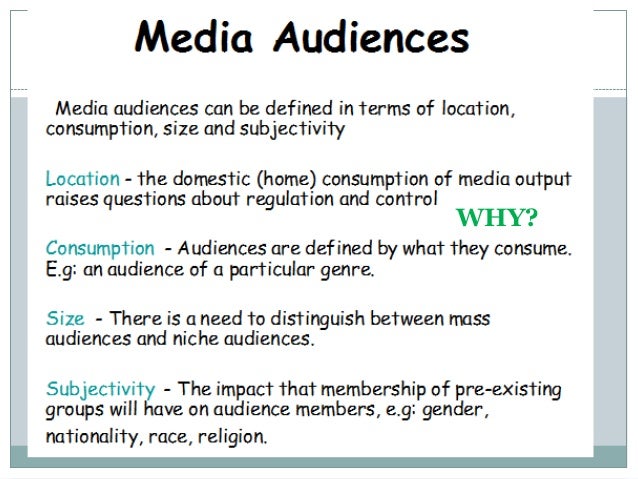
Theory/ Research: Audience Theories

3 QUESTIONS


  1. Why do audiences choose to consume certain texts?
  2. How do they consume texts?
  3. What happens when they consume texts?


There are three theories of audience that we can apply to help us come to a better understanding about the relationship between texts and audience.

1. The Effects Model or the Hypodermic Model - 
  • The consumption of media texts has an effect or influence upon the audience
  • It is normally considered that this effect is negative
  • Audiences are passive and powerless to prevent the influence
  • The power lies with the message of the text
Hypodermic Syringe…
> The messages in media texts are injected into the audience by the powerful, syringe- like, media
> The audience is powerless to resist
> Therefore, the media works like a drug and the audience is drugged, addicted, doped or duped.

The Bobo Doll Experiment… 
  • Children watched a video where an adult violently attacked a clown toy called a Bobo Doll
  • The children were then taken to a room with attractive toys that they were not permitted to touch
  • The children were then led to another room with Bobo Dolls
  • 88% of the children imitated the violent behaviour that they had earlier viewed. 8 months later 40% of the children reproduced the same violent behaviour


2. The Uses and Gratifications Model

  • The Uses and Gratifications Model is the opposite of the Effects Model
  • The audience is active
  • The audience uses the text & is NOT used by it
  • The audience uses the text for its own gratification or pleasure
  • Controversially the theory suggests the consumption of violent images can be helpful rather than harmful
  • The theory suggests that audiences act out their violent impulses through the consumption of media violence
  • The audience’s inclination towards violence is therefore sublimated, and they are less likely to commit violent acts


3. Reception Theory

  • Given that the Effects model and the Uses and Gratifications have their problems and limitations a different approach to audiences was developed by the academic Stuart Hall at Birmingham University in the 1970s
  • This considered how texts were encoded with meaning by producers and then decoded (understood) by audiences
  • When a producer constructs a text it is encoded with a meaning or message that the producer wishes to convey to the audience
  • In some instances audiences will correctly decode the message or meaning and understand what the producer was trying to say
  • In some instances the audience will either reject or fail to correctly understand the message
Stuart Hall identified three types of audience readings (or decoding) of the text:
1. Dominant or preferredWhere the audience decodes the message as the producer wants them to do and broadly agrees with it
2. NegotiatedWhere the audience accepts, rejects or refines elements of the text in light of previously held views
3. OppositionalWhere the dominant meaning is recognised but rejected for cultural, political or ideological reasons


Sunday, 14 September 2014

Theory: Doing Textual Analysis

After reading an article called 'Reading Media: Doing Textual Analysis' I understand the key concepts of analysing still and moving images.

SEMIOTICS 

> The study of signs.

'Micro' textual analysis refers to the study of specific elements of media texts that can be deconstructed through close reading
These micro features of texts are assessed in a thematic way to relate them to broader 'macro' conceptual models of media analysis. 

STILL IMAGE ANALYSIS

Media language describes the combination of written, verbal, non-verbal, aural & aesthetic communication & its instantaneous connection to meaning. 

Structuralism sought to identify structures that provide a network for meaning as located in texts. The focus is HOW meaning is constructed within a culture in a systemic way.

Media texts are combinations of lots of signs...
1) ICONIC SIGNS - direct resemblance to what they represent in the 'real world'
2) SYMBOLIC SIGNS - have a completely arbitrary / 'made-up' cultural connection to what they represent - we could change the meaning if we wanted to
3) INDEXICAL SIGNS - Have some kind of indirect or suggestive relationship to what they represent 

MOVING IMAGE ANALYSIS

There are 4 key elements...

  • camera... position, angle, movement, framing, lens choice
  • editing... intended to seem 'invisible' - helps convey meaning through the manipulation of time
  • sound... diegetic & non-diegetic
  • mise-en-scene...  overall atmosphere created by lighting, costume, setting and effects


GENRE


"A genre is a category of media text that comes to be recognizable through its conventions."


REPRESENTATION


"The media do not offer us a transparent 'window' of the world, but a mediated version of the world." - Buckingham 2003: 57)


- the sum of various 'micro' parts and relates to broader theories of collective identity, cultivation and ideology


"Meaning is a social production, a practice. The world has to be made to mean. Language and symbolization is the means by which meaning is produced." - Hall 1980: 67


NARRATIVE

  • Narrative analysis unpicks the ways that texts organize events into sequences and how these acts of sequencing become conventional.
  • Over time, conventional ways of telling stories cross over from one form to another in a process of 'remediation'.
  • Propp and Todorov are theorists who produced morphologies and typologies of how fictional stories tend to deploy a stock of repeated 'character types' and fit a structure beginning with equilibrium, moving through disruption and ending with a new equilibrium

Tuesday, 9 September 2014

Planning: Mood Board

I have made a few short films in the past, and have found that my favourite aspect of film-making is the editing. Therefore my documentary idea is a poetic form with a fast editing pace and many cut-away shots. I plan on presenting the major British stereotypes by including short (only few second-long) interviews of many people stating what they believe is the most 'British' thing. 

I plan on calling my documentary "What Makes Britain", whereby I will present quintessential 'English' things.

Monday, 8 September 2014

Planning: Initial Ideas


[I created this mind map on an app called 'Paper' on my  Apple iPad]

Saturday, 6 September 2014

Research & Planning: Documentary Influences

Kevin Macdonald...

Kevin Macdonald was born in Scotland in 1967, grandson of Emeric Pressburger, 
screenwriter/producing partner of 'Michael Powell in The Archers'. 

Pressburger was the subject of Macdonald's first film as director, the TV documentary The 

Making of an Englishman (Channel 4, tx. 1/1/1995). He went on to make several more 

documentaries for cinema and TV, often on cinematic personalities. 

Macdonald first came to fame with the Oscar-winning feature-length documentary One 

Day in September (1999) about the 'Black September' Palestinian terrorist attack on Israeli 

athletes at the Munich Olympic Games in 1972.

Macdonald followed up with another, even more powerful, dramatised documentary. 

Touching the Void (2003) was adapted from Joe Simpson's book about his ordeal in the 

Peruvian Andes in 1985.


(taken from the BFI - British Film Institute- http://www.screenonline.org.uk/people/id/874295/ )

Some of my favourite documentaries are those directed by Kevin MacDonald  like 'Life in a Day' & 'Christmas in a Day' as I love the editing style, whereby many different clips are put together to create the idea of viewing the whole world in one day. 


These types of documentaries can be known as the "poetic mode". 
Conventions of poetic mode documentaries include a variety of different shots, little or no narration or voice over, fast-paced editing. Also, there is often no particular narrative, instead they portray an aspect of something i.e. a day. 

Dawn Porter...

This is a screenshot of Dawn's official website page. Her documentaries appear to be fun and unique, and each one is about a completely different topic (unlike MacDonald, whereby he makes similar documentaries e.g. "... in a Day"). However, the topics that Porter covers are rather critical subjects which are 'problems' or issues in our modern society, like eating disorders ("Super Slim Me") and breast cancer. I think that this makes the documentaries relatable to their target audience. 

These documentaries fall under the expository-mode category. (?)

Here a some examples of Dawn's documentaries...


The two documentary makers / types are very different, and I can not yet decide whether to make a poetic/observational documentary like Kevin Macdonald's, or a more expository documentary like Dawn O'Porter. I will research into both types further before making a final decision.

Wednesday, 3 September 2014

Theory: Semiotics

Definition - The study of SIGNS (& the role of signs in social life)
                          > Examines how symbolic, written & technical signs construct meaning
                          > Saussure (a founder of semiotics) summarised it into this equation...
The sign = signifier + signified

A signifier = the form which the sign takes
The 'signified' = the concept it represents

Denotation & connotation...
Barthes analysed the denotative & connotative level of signs in a media text
He argues that the organisation of signs encodes particular messages and ideologies & that these ideologies can be revealed as constructed through textual analysis.

Research - http://www.slideshare.net/lizmedia/media-language-lesson-2013


Understanding Semiotics...

"Scary Mary" - a trailer made by a YouTube user where by the editing & sound of the original 'Mary Poppins' trailer have been changed to reconstruct the meaning & message.
The actual footage is the same, yet different signs & semiotics can completely change the concept.
Features which have been adapted to make the trailer a 'horror' genre film:

  • music - a scary/horror genre track used as background music - creates mystery
  • titles - black and white - plus ellipsis adds mystery
  • sound effects e.g. howling wind
  • fade transitions


Other examples...

1)


2)